Tuesday, February 03, 2009

Knowledge Puffs

Knowledge puffs up, but love builds up. - 1 Corinthians 8:1

I don't remember hearing this verse before. Maybe it is a different translation (New Revised Standard Version) than I have heard before. Regardless, there is a sort of simple elegance to it. Knowledge puffs up, but love builds up.

I can really see how it is that knowledge puffs up. Knowledge is something that we can earn on our own. Study, apply yourself, and you can obtain knowledge. Because we earn our knowledge, it gives us a certain sense of self importance. So many of us take great pride in how much we know, but outside of how much it might help us in our careers, what good is it? This is especially true if it leads to pride. Think about it, unless your name is Ken Jennings (the guy that won $1.5 million on Jeopardy), how many of us are going to be remembered for how much we know?

Love is different. I don't know that it is possible to make yourself love more. Where knowledge is all about ourselves, love is all about other people. That's where so much of the building up takes place. When you love, you build up other people, and they in turn build you up.

Both puffing and building will cause something to grow in size. When I think of something being puffed up, I immediately think of a balloon. A balloon inflates, it expands, but it is full of nothing but hot air. All it takes is a pin prick, and it is gone. Building something, on the other hand, takes time and effort. It grows slowly. But it is solid. A structure that is built well, on a firm foundation, can withstand quite a bit of force, and it can last. How long have the pyramids or the Great Wall of China been standing?

This verse was part of one of the readings in church this past Sunday (Feb 1), and, in a case of the Lord working in mysterious ways (OK maybe not really mysterious), I was able to work it into the lesson that I had for my 7th grade confirmation class. The theme of confirmation for the 7th graders is church history, and this week we were discussing the Counter Reformation, the 30 Years War, and the Inquisition. Pleasant stuff, huh? Earlier, the kids were so glad when we were through with the persecutions that the early church faced, and I could tell that they were disheartened to see so many of the same things happening again, only this time it was Christians doing it to other Christians. I pointed out to them that what we were talking about may have happened in the 1500s, but we aren't far removed from people writing books explaining what to do if your child married a Catholic. We talked about the difference between something being puffed up and built up, about how love emanates from God, but knowledge emanates from man. And then we talked about how it was knowledge, or at least what people believed to be knowledge, was at the root of much of what we were discussing. Wars were fought because one group thought that the knew better than everybody else. The inquisition was based greatly on the premise of I'm right, you're wrong.

There is one final point that I would like to make. Knowledge stands alone. Love stands with others. Like the old adage says, "United we stand, divided we fall." When we base our lives on knowledge, we are standing alone, and easily toppled. When we base our lives on love, by its nature, we are building up others, and they are in turn building us up. When tough times come, we have others to lean on, and that makes us all stronger. Knowledge puffs up. Love builds up. On which foundation will you base your life?

Saturday, January 31, 2009

One Small Step....

"Soon my Treasury Secretary, Tim Geithner, will announce a new strategy for reviving our financial system that gets credit flowing to businesses and families. We'll help lower mortgage costs and extend loans to small businesses so they can create jobs. We'll ensure that CEOs are not draining funds that should be advancing our recovery. And we will insist on unprecedented transparency, rigorous oversight, and clear accountability -- so taxpayers know how their money is being spent and whether it is achieving results." - Barack Obama, in his weekly address, January 1, 2009
I have mentioned several times in private conversations in the past week, that we should be looking at increasing the availability of small business loan guarantees as a part of any economic stimulus package. I was therefore encouraged when I heard President Obama mention that, as a part of a (hopefully) soon to be announced strategy, there would be an increase in loans to small businesses.

We are told that small businesses are the biggest job producers in the country so often that it has become something of a mantra. If this is true, then this should certainly be an area of focus for economic stimulus. Not only does it create jobs, but these would be loans and at least have the possibility of being repaid. There was a book that I read in the mid 90s, Unlimited Wealth, by Paul Zane Pilzer, that made an argument that layoffs were, in the long run, good for the economy. His reasoning was that the company laying people off would be at least nearly as productive, but with less overhead, and that a percentage of those that found themselves out of work would not find work, but would instead make work - they would start their own businesses, hire people, and the economy would expand.

I am not trying to make quite the same argument here. I think it is difficult to say that unemployment on the scale that we are currently seeing it is good, even in the long run. What I am saying is that it is not enough to merely pump money into the economy. It is important for us to pump money into the economy in ways that are going to be the most effective, and the key to that effectiveness is the velocity of money.

Money's velocity is essentially a measure of how quickly money changes hands. It is important because it acts something like a multiplier. Let's say that the government gives someone a stimulus check in the amount of $1,000. This individual isn't sure what to do with the money, but they cash the check and keep the money in their wallet until, some months later, he buys a computer for $1,000. The owner of the computer store puts that money in his safe, where it sits for another couple of months, until he remembers it is there, and he deposits it in his bank account. Assuming that this is where the trail ends, and the money only changed hands twice during the year, there are two people that have seen their income increase by $1,000. For their $1,000 investment, the government saw the economy grow by $2,000, and the money's velocity would be 2/yr. If, on the other hand the person that received the money immediately spent it, and the money ended up changing hands 100 times in a year, that investment of $1,000 would result in an increase of $100,000. If we are going to be spending money to try to get ourselves out of our current economic downturn, we need to identify where we can put it where it will work the hardest, and move the fastest. My suspicion is that small business, and especially new small businesses, is one of those places that we can get the most bang out of our buck.

As the saying goes, however, "the devil is in the details." It will be interesting to see the specifics of the Obama plan when they are released. I am hopeful that the administration will not use the stimulus in order to do a little "social engineering," and use it to fund businesses that they deem to be "worthy." If they can resist this temptation, this can be a powerful tool in stabilizing our economy. It can start to expand the economy, which will increase the tax base, and (because these would be loans, or loan guarantees) at least some of this money would be repaid (some businesses, of course, would not be successful, and will default on their loans).

Wednesday, January 28, 2009

Thoughts on Obama's First Interview

Barack Obama has given his first interview since becoming President, to Hisham Melham of Al Arabiya TV. Upon reading the transcript, I found that it contained potentially revealing insights into his world view. Of course, this could merely be a case of politician playing to his audience, but if it is not....
"But I also believe that there are Israelis who recognize that it is important to achieve peace."
Isn't that insightful? I know, it's hard to believe, but there actually may be some Israelis who might want peace. How many times has Israel been to the negotiating table? How many times have they signed cease-fires, or peace accords? How many times have they shown restraint in the face of a constant barrage of missiles and suicide-bombers? How long has Israel been at peace with Egypt, after the Camp David peace accords were signed? In the face of all this evidence, President Obama is somehow able to phrase it like it is some new revelation that there are Israelis that think it is important to achieve peace. The fact that he didn't even use the word most is also telling. Although he didn't quantify it, the impression that this statement leaves is that there are some Israelis that want peace, but that, in reality, their aren't that many. They certainly couldn't be in the majority. The truth is actually the opposite. Sure, there is probably a fringe minority in Israel that doesn't want peace, but the vast majority of Israelis yearn for it. They yearn for it so badly that, in the face of cease-fire after cease-fire that is broken, in the face of treaty after treaty that is circumvented, still they come back to the negotiating table, attempting to make peace with their neighbors.
"My job to the Muslim world is to communicate that the Americans are not your enemy. We sometimes make mistakes. We have not been perfect. But if you look at the track record, as you say, America was not born as a colonial power, and that the same respect and partnership that America had with the Muslim world as recently as 20 or 30 years ago, there's no reason why we can't restore that. And that I think is going to be an important task."
Here's a question - what has changed in the last 30 years? What events have transpired since the Carter administration that might have jeopardized the "respect and partnership" that used to exist between America and the Muslim world? I can certainly name a few. The Iranian Hostage Crisis. The bombing of the Marine Corps barracks in Lebanon. Two Intifadas. Saddam Hussein's overrunning of Iraq, and the subsequent Gulf War. Two bombings of the World Trade Center in New York (including 9/11). The USS Cole bombing. Nightclub bombings from Germany to Indonesia. Afghanistan. Iraq. If there has been a change in the past 30 years, that change has come, or at least has been initiated by, elements in the Muslim world. President Obama's remarks, while not being explicit, leave the impression that it is America that is somehow responsible for this change. If you go back more than 30 years, you would find that America's role in the region was far from idyllic. The ouster of the Iranian Prime Minister, Mohammed Mossadegh, in 1953 is certainly not a high point on the American resume. Let's face it, the United States has had a history of supporting authoritarian regimes in the region in order to protect its economic interests. This, if anything, has diminished in the past 30 years.
"Now, the Iranian people are a great people, and Persian civilization is a great civilization. Iran has acted in ways that's not conducive to peace and prosperity in the region: their threats against Israel; their pursuit of a nuclear weapon which could potentially set off an arms race in the region that would make everybody less safe; their support of terrorist organizations in the past – none of these things have been helpful."
It is hard to argue against most of what the President says here. He artfully praises the Iranian people and Persian civilization. He rightly identifies their threats against Israel and the dangers inherent in their nuclear program as not being conducive to peace. He then, however, mentions "their support of terrorist organizations in the past." (Emphasis mine.) Forgive me, but this doesn't pass the laugh test. Is Hezbollah not a terrorist organization, or does Iran no longer support it? I suppose, however, that I am just not properly parsing President Obama's words. The fact that Iran supported terrorist organizations in the past does not negate the possibility that they continue to support those same organizations in the present. The impression left by his words, once again, is different.

If these three statements truly reflect our new President's world view, we could be in for a long 4-8 years. Barack Obama is so many things that George W. Bush is not. He is both eloquent and charismatic. While President Bush's words grated against my ears, I love to listen to President Obama's soaring rhetoric. But this man who comes to the Presidency with a scant four years separating him from the Illinois Assembly may also be naive, and in the tangled web of Middle Eastern politics, that could prove to be a dangerous thing.

Tuesday, January 13, 2009

A State of Bondage

California is broke. The largest state in the Union can't pay all of its employees, its vendors, or us, the taxpayers. It's hard to imagine that California, which, if it were a country, would be the 7th largest economy in the world, could get itself into such a mess. Obviously, there are a number of contributing factors to the predicament that California finds itself in - anything from employee contracts, to pension fund liabilities, to required spending thresholds. Another, however, is the state's increasing reliance on bond measures to finance project, especially public works projects.

It wasn't always this way. There was a time when California was forward thinking, looking ahead at projected population growth, and allocating funds to improve the infrastructure necessary to support its burgeoning citizenry. In the 50's and 60's, California's roads and schools were the envy of the country. Unfortunately, this is no longer the case. Anyone living in the Golden State today can attest to the fact California has now lost its race to keep the infrastructure ahead of its population growth.

As of December 1, 2008, California has on its books, $56,944,224,000 in existing bond obligations, with the approval from voters to issue nearly the same amount ($56,823,816,000) in additional bond issues. This does not include any of the myriad of bond measures that passed on the November ballot. Fortunately, the ability to issue bonds does not require that they be issued, so there is hope that the state will not use the entirety of its line-of-credit. Since 1960, the state has been authorized by voters to issue $141,362,000,000 in general obligation bonds. Approximately 2/3 of the debt has been issued, with about 60% of that amount still outstanding.

This year, estimates have California running some $42 billion in the red. Between the housing slump and the sagging economy, state revenue is down. In the middle of a national fiscal emergency, California voters approved another $9.95 billion for a high speed train between Northern and Southern California, $990 million for Children's Hospitals, and $900 million for aid to Veterans.

Don't get me wrong, these may all be good things, bond issues are always for good things like schools, roads, libraries, police, fire and the like. Hey, who is against those things - certainly not me. The problem is, money is fungible. Does anyone think that if a school bond is not passed, there will not be any money for school improvements? What happens is, because a new source of funds has been found for improving schools, the money that would have gone for schools can be moved to other projects. This is key. When you vote for a bond measure, you are not just voting on the projects that the bond is used for, you are also voting for all the other projects that will be funded with the money that would normally have been allocated to that project.

There's evidence for this, too. In 2002, we passed the Kindergarten-University Public Education Facilities Bond Act of 2002 (K-12) , which authorized $11.4 billion in bonds, with $1.5 billion of this amount yet to be issued. Then, in 2004, we passed the Kindergarten-University Public Education Facilities Bond Act of 2004 (K-12) , which authorized another $10 billion in new bonds. We have issued $7 billion of this, with another $3 billion available. One might think that was enough, but, in 2006, we passed the, you've got it, Kindergarten-University Public Education Facilities Bond Act of 2006 (K-12) - another $7.3 billion, again with $3 billion unissued. This is not an outlier, either. There were New Prison Construction Bond Acts in 1986, 1990 and 1992; Veterans Bond Acts in 1982, 1984, 1986, 1988, 1990, 1994 and 2000; California Safe Drinking Water Bond Laws in 1976, 1984, 1986 and 1988, Clean Water Bond Laws in 1970, 1974 and 1984, a Clean Water and Water Conservation Bond Law in 1978 and a Clean Water and Water Reclamation Bond Law in 1988. I could go on. Why would we need the ability to borrow millions upon billions of dollars, year after year, in consecutive election cycles? Perhaps because the real reason was to free up dollars for other projects.

There's another problem, too - Prop. 13. Prop. 13 isn't going anywhere, nor should it. The problem is in the juxtaposition of the requirements of Prop. 13 and the requirements to pass a bond measure. Because it takes a 2/3 majority to increase taxes, it is much more difficult to increase revenue through a tax increase than it is to increase revenue, through debt, by passing a bond measure. But here's the thing about debt - it reduces your capacity for future expenditures because of the interest you have to pay in addition to the principal. Sure, because of inflation, we pay back our debt in dollars that are worth less than the ones we borrowed, but that merely reduces the cost, it doesn't eliminate it. And if this recession worsens, we could end up in a deflationary period, where we would potentially pay debt in dollars worth more than the ones that we borrowed.

I propose that we pass a new initiative in California, a companion to Prop. 13, that would bring the requirements to pass a bond measure more in line with what it takes to raise taxes. My preference would be to make the requirements the same - a 2/3 majority, but I would settle for 60%. In the case of the three initiatives mentioned above, only one of the three would have passed the 60% threshold. The Veterans Bond Act of 2008 passed with 63% of the vote. The High-Speed Train measure received 52.5% of the vote, while the Children's Hospital Bond Act received 55.1%.

How many of us can go to the store and buy without looking at the opportunity costs inherent in a budget? Within any budget, there are choices to be made, if you purchase one thing, it means that you don't have the funds to purchase something else. When we vote on bond measures, we don't have enough information. We don't see everything that is on the table. All we see are schools and roads and clean water, and we think to ourselves, "yeah, we need that." This is the job that we pay our elected representatives to do for us, and we usurp their responsibility at our own peril.

Saturday, January 10, 2009

B(c)S - Part II

There is a fundamental flaw in the way that we determine the teams that vie for the BCS National Championship. The problem is that, as long as you are limited to choosing only the top two teams. Unless you have two, and only two, teams from the major conferences that go undefeated, it will be difficult, if not impossible, to narrow the field to two teams.

The problem is not just that the top teams rarely play each other, it's that they don't even play many common opponents, unless they happen to be in the same conference. Prior to bowl season, Florida, Texas, USC and Utah played a grand total of two common opponents. Utah and USC both played Oregon State, while Florida and Texas both defeated Arkansas. Not until the bowl games had been played did we see how Texas and USC matched up against Ohio State, Utah and Florida against Alabama, and Florida and Texas against Oklahoma.

Because there is not enough meaningful data to be able to the best team(s), there is a tendency to rank the conferences that belong to, instead. This is how we ended up with Oklahoma v. Florida. By most accounts, the Big XII and the SEC were considered to be the two best conferences in the country. Oklahoma and Florida were the champions of those two conferences. It didn't matter that Utah was undefeated, or that Texas beat Oklahoma, or that USC might have a better loss when compared to Florida. It sounds reasonable, doesn't it? The BCS Championship was ultimately what many people have been asking for, a "plus-1" game. It is just based on the regular season, without taking the bowl games into account.

The problem with this is that, just as we don't have enough information to determine which is the best team, we also don't have enough information to determine which is the best conference. Nine out of the twelve games that a team plays are against teams in their own conference (ten of thirteen for conferences with a championship game). That means that three-quarters of the data by which we evaluate conference strength is based on the conference playing with itself. Going into the bowl season, who would have picked the PAC 10 to go 5-0 in bowl games? Does that make the PAC 10 the best conference in the country? No, but neither are they the weak step-sister to the SEC and the Big XII as they were made out to be.

Many have suggested that the way to solve this is to play one more game after all of the bowl games - a "plus-1" scenario. Yet, this year, a "plus-1" would solve nothing. Any teams that were not invited to play in the plus-1 game would still have a legitimate claim that they should have been. Maybe the "plus-1" scenario would help settle a debate in some years, but in other years it would merely extend it. This year was a great example of a year that the "plus-1" would be insufficient.

The argument against a playoff system is that it would diminish the importance of the bowl games. I would suggest, however, that the bowl games be the starting point of a "plus-2" scenario. This would allow the BCS affiliated bowl games to retain not only their importance, but also their traditional match-ups. Under this scenario, we would return to eight teams that would play in the four BCS affiliated bowl games, all of which would be played no later than January 2. The eight teams would be, first, the winners of the six BCS conferences - the SEC, ACC, Big East, Big 10, Big XII and PAC 10 - followed by two "wild-card" teams. As is currently the case, the top ranked non-BCS conference team would receive an automatic wild-card bid, provided it finished in the top eight of the final BCS standings, otherwise, it should be the top two remaining teams. Winning your conference should mean something. If you can't win your conference, you take your chances - maybe you are in, maybe you're not. This year, Texas might have had a legitimate beef, tying for the Big XII South title, but missing out on the Big XII championship game because of the three-way tiebreaker rules set out by the Big XII. Based on this, the eight playoff teams this year would be Florida (SEC), Oklahoma (Big XII), Virginia Tech (ACC), Cincinnati (Big East), Penn State (Big 10), USC (PAC 10), and wild-cards Texas (Big XII) and Utah (MWC). As mentioned previously, the Orange, Sugar, Fiesta and Rose Bowls could retain their traditional affiliations, which could have resulted in the following match-ups:

Rose Bowl
USC v. Penn State

Fiesta Bowl
Oklahoma v. Utah

Orange Bowl
Virgina Tech v. Texas

Sugar Bowl
Florida v. Cincinnati

Okay, I admit it, I manipulated these match-ups to ensure that the same four teams that are in the national championship discussion could win and move on. Were these the match-ups, who knows what might have happened, but who wouldn't be excited to see match-ups of USC v. Utah and Florida v. Texas next Saturday, with the winners contending for the championship the following week.

Would this system be perfect? Certainly not. Alabama ended the year ranked fourth in the nation, yet would not have a chance to contend for a championship. As noted above, if you don't win your conference, you take your chances. It could just as easily have been Texas ranked fourth and Alabama third, leaving Texas on the outside looking it. Or Oregon State could have won the PAC 10 with a 9-3 overall record, and USC, ranked fifth, would have had to sit on the sidelines. Wouldn't it be better, though, to be arguing over who the seventh and eighth teams should be, rather than the first and second? And enough of this nonsense about "every game being an elimination game." If that were really true, Utah would have gotten their shot, as they didn't lose a game, and therefore should not have been eliminated from contention.

Think, also, about the additional revenue that would be generated by having not one, but three additional games (the two national semi-finals, and the one national championship games). These games could be played at the sites of the existing BCS games. Instead of getting an extra game once every four years, as is currently the case, each site would get an additional game three out of every four games. Add to that the additional revenue generated by the advertising during the games, additional sponsorship, and there would be enough money to make it worthwhile. Two more weeks of college football, a playoff system that embraces the the existing bowl structure, and a Football Bowl Subdivision championship played the week before the Superbowl. That sounds like College Football Nirvana.

Friday, January 09, 2009

B(c)S - Part I

Last night, the Florida Gators defeated the Oklahoma Sooners, and have been declared the national champions of Division I college football. The final gun signalled the start of the annual debate about which team was really the best in college football this year. Every year, the awarding of the BCS Championship Trophy does more to start this debate than end it, as it was designed to do. This year, there are four teams (Florida, Utah, USC and Texas) that can make legitimate arguments that they should be considered "national champions."
Florida is the team that will go down in the record books as the 2008-09 National Champions. They won the BCS National Championship game. They ended the year on top of both the AP Poll and the ESPN/USA Today Coaches Poll. They were champions of the Southeastern Conference, and beat the champion of the Big XII conference, arguably the two top conferences in the nation this year. But still, there is that one blemish on their resume. One loss, at home, to Ole Miss. And so there are questions.
USC seems to be in this position every year. Every year they put up one bad game, and it haunts them. This year, the stinker occurred in Corvallis, against a pretty good Oregon State team. In the end, they were able to make it close, losing to the team that would end the year as either the 18th (AP) or 19th (USA Today) ranked team in the country. How does that loss compare to Florida's loss to Ole Miss, which ended the year ranked either 14th (AP) or 15th (USA Today) - a loss that occurred on their home field? Yet Florida was invited to the BCS Championship game as the #2 team in the country, while USC was ranked #5 and played Penn State in the Rose Bowl. USC plays in the PAC 10, which is often characterized as USC and the 9 Dwarfs. But the PAC 10 finished with four teams (USC, Oregon, Oregon State and California) ranked in the top 25 of the USA Today poll (Cal was 26th in the AP poll), while the juggernaut known as the SEC finished with... four teams in the top 25 (Florida, Alabama, Georgia and Ole Miss). Maybe, then, it was the strength of schedule that put Florida over the top? Florida played five games against teams that ended the year in the top 25 of the USA Today poll, Ole Miss, Georgia, Florida State, Alabama and Oklahoma, going 4-1 against that competition. USC, on the other hand, played Ohio State, Oregon State, Oregon, California and Penn State - five teams from the end of year poll, and went 4-1 against that competition. Oh, and the PAC 10 went 5-0 in Bowl games (yes, one of those was Oregon State's 3-0 win over Pittsburgh).
Of the 1 loss teams left out of the BCS Championship game, Texas has, perhaps, the best loss on their resume. Their one loss came at the hands of Texas Tech, who ended the year as the 12th ranked team in the country according to both the AP and USA Today. Not only that, but Texas Tech had to pull off one of the most memorable plays in recent memory in order to secure the victory. Texas is also the only team in the end-of-year top 5 that can boast a victory over one of the two teams that played for the National Championship. Rest assured, we will see signs proclaiming the final score of 45-35 when the Red River Rivalry resumes in 2009. But is a Texas team that struggled to beat Ohio State, 24-21, the equal of a USC team that beat Ohio State 35-3?
Utah has a pretty good argument that they are the real National Champions. They were the only team to go undefeated, 13-0. They stood against all comers, and remained unblemished. In their final game, they beat Alabama, a team that spent five weeks atop the polls, a team that took Florida to the limit. After their first 3 possessions, they were ahead, 21-0. Alabama did manage to cut the lead to 21-17, but then Utah scored the final 10 points for a final score of 31-17. Oh, and that Oregon State team that beat USC in Corvallis? Utah beat them, too - 31-28. It isn't like they played a slouch of a schedule, either, as Utah went 4-0 against the end-of-year top 25.
In the end, there should be only one, but we are left not with one, but four teams, each with a legitimate claim to the title. The uncertainty leaves us dissatisfied. Even the most ardent fan feels it, the doubt, the uncertainty, the not knowing what would have been, what could have been. Such things were meant to be decided on the field, not by some sort of computer simulation or popularity contest. Even the Gators, who are speaking with the bravado of those flush with victory, have doubt. What if it had been USC, Utah, or Texas that had stalked the opposing sideline? Would the outcome have been the same? But there is no knowing what might have been, so here we are, at the same crossroads we have faced countless times before. Lost. Confused. Empty. Unsatisfied.

Monday, April 16, 2007

Reporting from the Missionary Position

Others can and will comment on the senseless killings that took place on April 16th, 2007 at Virginia Tech. Many of them will do so far more eloquently than I can ever hope to. I will leave that to them. I wish, instead, to comment on the equally senseless media storm that is now centered on the university.
I suppose that some of it is to be expected. It is entirely reasonable for the major media outlets to dispatch a reporter or two to the scene of the bloodiest stooting in the country's history. I was disgusted, however, when I saw that Katie Couric and Brian Williams, two of the three anchors for the major networks, were already there at the scene. I would be surprised if Charles Gibson and Anderson Cooper weren't at the campus as well, I just didn't happen to see them.
What purpose was there in having the network news broadcast from the crime scene? Was there any value added by the anchor's presence? Well of course there was - ratings.
The news is an interesting business. As with all broadcast media, it is driven by ratings, and as unfortunate as it may be, bad news sells, and the worse the news, the better it is for the ratings. There is a difference, however, in thoroughly reporting the news, and exploiting the news. The reporting on the Virginia Tech shootings have crossed this line.
This story is certainly important enough to dominate the news. The problem is that there isn't enough information available for it to dominate the news. For students that were involved in the event, the last thing that they need is microphone stuck in their faces. Students not involved, on the other hand, do not have much (if anything) to offer. Telling the story is one thing, but to attempt to cover a story like this from every conceivable angle, not to mention calling in additional talking heads to speculate and postulate on what happened, why it might have happened and/or what could or should be done to prevent it from happening again, it crosses the line to exploitation.

Monday, March 19, 2007

Dueling With Immersion

Today, I learned a new term, Dual Immersion. My children’s school is supposed to be implementing this program over the next several years. At Sunnyslope Elementary School, Dual Immersion will require a multi-year commitment, beginning in Kindergarten. The two Dual Immersion Kindergarten classes will have 90% of their instruction in Spanish, and 10% in English. As the students progress to 1st Grade, the ratio will change to 80% Spanish and 20% English. 3rd Grade will by 70% Spanish and 30% English and by the 5th Grade, the ratio will be 50/50.


I am all for introducing secondary language in our Elementary Schools. I believe that there is solid evidence that language skills are more easily obtained by children at that age. That being said, I have concerns about this program and the way it will be implemented. On the surface, it appears to me that is likely that Dual Immersion is a way to circumvent Proposition 227, California’s English Only initiative. Perhaps I am wrong, but to prove this to me, there are a few questions that I need to have answered.


Who is this intended to benefit, English Speakers or English Learners? With a 90/10 split in instruction time to begin with, I have a hard time believing that it is both. If it is good for English Speakers to have 90% of instruction in Spanish, wouldn’t it be good for English Learners to have 90% of their instruction in English? If it is good for the English Learners to have 90% of their instruction in their native tongue, isn’t it a disservice to the English Speakers to have only 10% of their instruction in their native tongue?


How will English Speakers in a classroom that has 90% of the instruction in Spanish not fall behind in the core curriculum? The documentation that I have read indicates that by the time students in a Dual Immersion program reach the 6th Grade, they are at or above grade level. The same documentation, however, indicates that there is, either by design or by chance, a higher degree of parental involvement with students enrolled in Dual Immersion. Many studies have shown that higher parental involvement is an excellent indicator of student performance on standardized tests, which begs the question: What would these students test scores have been had they been enrolled in a more conventional program, with the same level of parental involvement? How can we be assured that it is the language skills that have made the difference, and not the additional parental involvement?


Why not just add Spanish to the Elementary School curriculum, at least on an optional basis? This question is actually rhetorical. There isn’t time to add Spanish to the curriculum. We are asking our children to do more and more at a younger and younger age. I see my 4th graders asked to do math that we didn’t see until 8th or 9th grade. I see my 5th and 6th graders expected to exhibit levels of cognitive thought that they aren’t ready for yet. My kids are struggling to keep up as it is, I can’t imagine what it would be like if we were to add a secondary language to the mix?


What assurances do we have that this isn’t merely a way of circumventing Prop 227? As stated above, it is counterintuitive that both English Speakers and English Learners will benefit equally from a disproportionate percentage of instruction being in Spanish. The thing is, it appears that the move away from bilingual education is working. Standardized test scores have improved since the passage of 227. This indicates that the better way to learn a second language is through immersion programs. If we are using programs such as this as a back door around 227, we may be doing a disservice to our English Learning students.


Do we know what the demand is for this program? The current plan is to have two kindergarten classes taught as Dual Immersion classes in the first year of the program. Do we have enough demand for this program within the area serviced by Sunnyslope Elementary? If there isn’t, there is talk of allowing students from elsewhere in the district to transfer to Sunnyslope. Doesn’t this open up the possibility that some kindergarteners in the Sunnyslope area will have their places taken by students from outside the area because they may not want to be involved in the program. From what I understand, these classes are in place of standard kindergarten classes at Sunnyslope, not in addition to them. Will students be forced to attend schools farther away from home because of this program? I hope not. I hope that no parent is told that their child can attend Sunnyslope, but the only slot that is available is in a Dual Immersion class.


All this being said, this is an optional program. I am a firm believer that we need more choice in our schools, not less. As long as this program is voluntary, and as long as it is not meant as a way to get around Prop. 227, I am not opposed to it. If I had a child entering kindergarten, I don’t think that I would sign up for this. Other parents can make their own choices

Friday, September 23, 2005

Steele Equivocating

The Washington Post ran an editorial on Sept. 23rd that condemned the actions of staffers of the Democratic Senatorial Campaign Committee, who illegally obtained confidential credit reports on Maryland Lt. Gov. Michael Steele. OK, condemned may be a bit strong for what the Post editorialized, but they did say quite firmly that, if they did it again, The DSCC should be prepared to go on time out. I am quite willing to say that I don't know enough about what happened to know if this story has legs enough to make it down the driveway, let alone around the block, but I did find a couple of things quite interesting about this editorial.
First, nearly as much time is spent discussing how Republicans do this sort of thing, too. I can't help but wonder, if the situation were reversed, would the piece have gone on about how both sides pull dirty tricks on the other? Or would the commentary have focused more on the specific dirty trick involved. The Post does its readers a disservice if when one side of the aisle is caught with its hand in the cookie jar, everyone is at fault, while when the other side is caught doing something untoward, the focus is on them alone.
Then, the Post closed with what I think is an absolutely preposterous comparison.
As political dirty tricks go, snooping for financial dirt on Mr. Steele by illegal means strikes us as roughly on a par with eavesdropping on a rival party's private telephone conversations, as Virginia Republican officials did several years ago.

Excuse me, but this doesn't seem like it is even roughly on par with eavesdropping. The correct comparison is that it would be equivalent to illegally tapping a rival party's telephone. I don't know if this is what Virginia Republicans did or not, but that would be roughly the same. The Mainstream Media likes to pretend that they are even-handed, but editorials such as this make that difficult to believe.

Thursday, September 22, 2005

Cub Scout Camp - Alex


Alex - Your Move
Originally uploaded by brent2mnen.

This is Alex in the middle of his first game of chess. He won this game almost by accident. He attempted to make an illegal move with his queen and put his opponent into check. When told that there was a legal move with the queen to put him in check, he took it. I looked for a moment and realized it was checkmate. The two boys running this activity were amazed and came running over to confirm the win. It was the only checkmate of the session.

Alex really impressed me during his second game of chess. As I mentioned earlier, he tried to make a couple of illegal moves in the first game, but by the second he seemed to have all the pieces down. He wasn't able to finish his second game, but if you were to have decided the game on points, he was ahead when time ran out. I am going to have to play chess with both of the boys. I was really pleased that they have both taken a liking to the game. As the grow older, and get better at the game, it will be a wonderful thing for us to do together. I suppose that I will have to learn to play multiple games at the same time, so that no one feels like they are being left out. Hopefully, that will also cut down on the kibitzing.

Alex really loved swimming. He was fearless, too. When the boys first got to camp, they took a swimming test. That wouldn't have been a problem except for one thing - Alex doesn't swim. That little detail didn't phase him in the least, though. He was taken to the deep end of the pool and, over the objections of myself and two other parents that were with us, jumped right in when he was told to. I don't know how much of it was from fear, and how much of it was from the cold water, but when he emerged, he had a look on his face that I had not seen before (and hope never to see again). Even that experience, though did not deter is love of the water, and by the end of the summer he had taken swimming lessons, and earned both his Swimming Beltloop and Pin.

Cub Scout Camp - Ryan


Ryan - Fishing
Originally uploaded by brent2mnen.

It isn't often that you see Ryan sitting still for this long. This picture was taken while Ryan was at Camp Wiley, a Cub Scout camp in Running Springs, CA. I don't know about you, but this picture reminds me of something from the Andy Griffith Show. Unfortunately, I wasn't around to see him catch his fish. If you were to ask him, he would tell you that he caught a Blue Gill (he says it as if it were two separate words). I can't tell you how good the Cub Scouts has been for Ryan. Just at camp, he was able to go swimming, shoot a BB gun, learn some Archery, whittle (yes, with a real pocketknife). I have to admit, though, that I was worn out after a few days of Cub Scout Camp. I spent much of the time running back and forth between Alex's group, and Ryan's - which is why I missed capturing his fish on film. I think that I went through a couple of liters of water daily. I was very grateful that I had purchased a hydrating backpack to carry around with me.

Ryan was a star meteoroligist, too. The boys that had just graduated to Bear Scouts (going into 3rd grade) were "Weather Bears", and got to announce what the weather was going to be for the day. They also had a class in which they learned a little more about meteorology. Ryan already knew most of the different types of clouds (cumulus, cumulonimbus, stratus, cirrus, etc.).

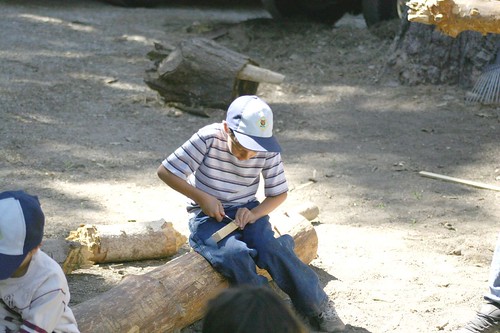
Did I mention that one of Ryan's activities was whittling? Ryan handling a firearm? I could handle that. Ryan in Archery class? No problem. But Ryan with a knife was almost more than I could bear. This class was the reason that I didn't make it back to see Alex in Archery class. After a quick lecture in knife safety, the boys were each given a knife and a piece of wood to whittle. Fortunately, these knives were very dull, unlike the knife that I purchased for Ryan to use. Ryan then proceeded to wrap his fingers completely around the blade to open and close the knife, and because he was more to the side of the boys conducting the class, it wasn't noticed.

Before the class started, the parents were instructed not to speak to the boys. The older gentleman that ran this activity said that the only injuries he had ever had were due to parents distracting their children. Seeing my son with his fingers around the blade of a knife, however, was more than I could take. As Popeye is wont to say, "That's all I can stands and I can't stands no more." It took some effort, but I finally got the instructors' attention and they went over and supervised Ryan a bit more closely. This actually happened a couple of times before they realized that Ryan needed more supervision than most boys, but by the end of the session, someone was sitting next to Ryan the whole time. I was relieved when this activity was over. Looking at his Bear book, though, I noticed that Ryan is supposed to do a carving. I think that we will have him carve soap... using a plastic knife. As it is, his Cub Scout knife stays in my possession and only comes out when Ryan can be supervised.

Friday, September 02, 2005

Open Houses

Dennis Prager, who I listen to regularly on the radio, is trying to organize people that will open up their homes to families displaced by Hurricane Katrina. His plan is to limit the stay to 1 month, so that there are fewer complications. If a family needs more than a month, they would move to a different home. If you are interested, you can give your name to Dennis to sign up at his website.

Thursday, September 01, 2005

The Best of Times.... The Worst of Times

It was the best of times....
Never is the character of the American people more evident than in times of crisis. At home or abroad, Americans are among the most compassionate and generous people on the planet. This is again evident in the aftermath of Hurricane Katrina, which looks to become the most devastating hurricane ever to hit the United States. What do Americans do when disaster strikes? They band together. They dig deep. Everywhere you look, there are stories that show the best of what mankind can become.
It starts at a young age. Children across our country are taking hammers to piggy banks - forgoing Barbies and baseballs, because they want to help. They are creating lemonade stands - not so that they can have a little spending money, but because there are people in Louisiana, Mississippi and Alabama that don't have a room, a shirt or a decent meal. They are donating their favorite stuffed animals - because they know that there are children out there that lost their own.
The city of Houston has reached out and is taking in tens of thousands of people that have been trapped in New Orleans. Many Houston hotels have reduced their rates, rather than increase them. The city is allowing cars with Louisiana plates to have free parking. The governor of Texas has offered to take the children of New Orleans that have been relocated into the Texas public schools.
I was listening to the radio today, and I heard a woman from Arizona say that she would like to take a family into her home. She said that she had room for a family of four. Many of us are reaching into our wallets, offering to help in that way, but this woman was offering to let a family of strangers into her life. I know of no more generous offer than to share your home, your life, with a complete stranger.
Who is it that says that Corporate America is heartless? Corporation after corporation is donating Food, Clothing and Water, as well as cash donations to charities in order to help people that have been devastated by Katrina. GM and Nissan are sending vehicles to help with disaster recovery. Budweiser is bottling water, not beer and sending it to the hurricane ravaged Gulf Coast. This article in USA Today documents even more of the efforts that Corporate America is making to help out in this time of disaster.

It was the worst of times....
Just as a disaster can bring out the best in people, it can also bring out the worst. The looters were just the beginning. I don't hold it against people that have taken the food, clothing or medical supplies that they might need to survive, though I believe that they should attempt some form of restitution at some future date. Televisions, however, are not a necessity. It is tragic that, just as the rest of America is being selfless, there is a portion of it that is being completely and entirely selfish. I have heard reports of trucks that are coming into the areas with supplies being hijacked. A medical airlift attempting to get some of the sick and the injured out of the Superdome was at least temporarily suspended after someone apparently fired a shot at a military helicopter. There are reports of police officers turning in their badges. They have lost everything, and don't feel that it is worth it to risk their lives battling thugs and looters.
Who can blame them? I have heard many complain about the lack of relief - that there is too little, too late. At the same time, though, there is a portion of the population that is actively hindering rescue and relief operations. Shots are being fired at police officers. Violence is being threatened against rescue workers, in an attempt to have their family attended to first.
Respect. This is a word that is often bandied about. Respect, though, is something to be earned, and the best way to earn it is to act respectably. Unfortunately, there are so many good people that are suffering because of the actions of these thugs. I don't remember people that were affected by last December's tsunami being this ungrateful, or this demanding, either. It doesn't help to dwell on the things that one doesn't have - it is much better to be grateful for what we do have.

Wednesday, August 03, 2005

Immigration, the Nanny State and Unintended Consequences

It was about a week ago that I was driving home from work, listening to talk radio as is my habit, when I overheard a host talking about how the American Welfare State was an incentive to illegal immigration. I don't know that people come to the US to take advantage of our welfare system. I tend to believe that most people come to the United States looking for work. And let's face it, work is here to be had. Employers, especially in the agricultural sector, often contend that the reason they need to hire immigrants is that American workers are unwilling to do the work - of course, they always seem to leave a very important phrase off of this statement, "at the wages they offer." And that is when it dawned on me. The American Welfare State may, indeed, be an incentive to immigrants - not because they come for the benefits, but because it gives American workers an incentive not to work.
Why should a person do the back-breaking work of picking strawberries when they can exist - maybe not well, but exist nonetheless - on the government dole. Even if a worker could make more cleaning hotel toilets, how much more would they need to be compensated before they chose to do that instead of being paid for doing nothing at all? The Welfare State may actually be artificially raising what workers perceive to be a "living wage", while at the same time enticing immigrants and employers to find common ground in the underground economy.
I was unemployed recently, for approximately three months. I was able to make ends meet during that time by selling the small portfolio of stock I had accumulated, spending the minimal severance package I received, my tax refund, and unemployment. I doubt that I could have lasted much longer without starting to skip payments on credit cards, my mortgage, etc. I was picky, though, in my job search. I confined it companies in my immediate area, not desiring to have to make a long commute which would take time away from my family. That being said, as my funds ran short, and I started to experience shortfalls, I would have lowered my expectations, made compromises, and ultimately done whatever I had to do to support my family and pay my bills. I don't think that other people are any different. We will do what it takes to survive, but if we can survive before "going to the mattresses" we are likely to make trade-offs.

Thursday, July 28, 2005

The Case For Retirement

Much has been made about Chief Justice William Rehnquist's decision to remain firmly planted on the bench of the Supreme Court. Many have questioned whether his health is such that he has the strength, both mental and physical, to carry out his duties. The decision recently announced in Kelo v. New London, however, makes a compelling case for the retirements of Justices Stevens, Breyer, Ginsburg, Kennedy and Souter.
These five Justices have essentially said that private property isn't private. Rush Limbaugh claims to have talent on loan from God. The Supremes have now declared that our property is merely on loan from the government, and can be taken for nearly any reason. According to Justice Stevens, the government of New London's "determination that the area was sufficiently distressed to justify a program of economic rejuvination is entitled to our deference". In other words, whatever the city wants, the city gets. There is no standard by which to determine if a city justly has determined that economic rejuvination is necessary. They just have to find that it is, and the Supreme Court will defer to that determination.
It didn't take long for municipalities to get the message - it was open season on private property. The decision came down on June 23, 2005. John Revelli's family had owned and operated Revelli Tires in Oakland for 56 years. No more. On July 1, the city of Oakland evicted both John Revelli and a neighboring business owner so that apartments could be built on their properties. For the full story, refer to this article in the San Francisco Chronicle. This was not the first, and certainly won't be the last, instance of this kind of gambit.
Rarely is a decision by the Supreme Court as wrong as this - so wrong that both the Left and the Right are up in arms over it. For those that are concerned about the direction that John Roberts will take the Court, this should be some consolation. If Roberts turns out to be the conservative Justice that he is expected to be, he would have come down on the right side of this decision. It should be noted that it was the Court's most liberal members that have ripped the foundations of our homes and businesses out from under us. I pray for the speedy retirements of these five justices, and their replacements by Justices that understand their role, and the laws and principles that they are sworn to uphold.

Monday, July 25, 2005

Here's to Bush's Health

I was floored today, when I read of legislation that has just made it out of the House Energy and Commerce Committee. Apparently, John Shadegg (R) of Arizona has introduced legislation that would allow consumer to purchase insurance from any one of the 50 states. This, by no means, ensures that the legislation will become law, but it is a step in the right direction. As it currently stands, each state passes its own legislation that regulates the insurance carriers in that state, which leads to a wide array of pricing structures throughout the country. As the Wall Street Journal points out, this is precisely the sort of thing that the Commerce Clause was written to address. These regulations have the same effect as tariffs, making it impossible for companies that do business from one state to do business in another state. Allowing consumers the flexibility of choosing policies from any state they wish will allow them to pick plans that best suit their needs. President Bush has apparently endorsed the Shadegg proposal, which could result in the best health care legislation we have seen in some time.

Wednesday, May 11, 2005

They Still Have US to Kick Around

Thomas Friedman really hit the ball out of the park with his article today in the NY Times. If Iran and North Korea do indeed develop and test nuclear weapons, whose fault will it be? In the eyes of the world, it will be the fault of those Americans, no doubt. But Friedman questions whether Europe and China have the political will or even desire to pressure Iran and North Korea into giving up their radioactive dreams. The US has already severed nearly all ties with both countries, and therefore has little leverage left. Friedman is especially insightful when he makes this statement:
Are the Europeans and Chinese behaving cynically? Of course, these are the very countries constantly complaining about U.S. "hegemony," and calling for a "multipolar world." Yet the only thing they are really interested in being a pole for is to oppose the U.S. - not to actually do something hard themselves to stabilize the global system.
They complain when we act like the world's only superpower and they complain when we don't. It is almost enough to make you want to return to those halcyon days of American isolationism and quit being the world's policeman. But the world needs a policeman, and who else will take that role? The Europeans? The Chinese? Do we really want them to?

Monday, May 09, 2005

Dead Last

I may not have the quote exactly right, but I heard LA Mayoral candidate Antonio Villaraigosa state today that "of the top 67 largest cities in America, Los Angeles' roads rank dead last." He may be right, I can't quibble about the number, but I find it hard to believe that the survey took into account only 67 cities. Maybe 50 cities, or 75, or even 100, but not 67. If LA had come in the 44th position, the quote would have read "of the top 44 largest cities in America, Los Angeles' roads rank dead last." The same would be true if they had been 23rd, or even 7th. The key thing is that Villaraigosa was able to say that they were "dead last."
I don't have a horse in the LA Mayors race. I don't live in Los Angeles, and wouldn't care much for either candidate if I did. That being said, the use of statistics in this manner is disingenuous at the very least. As my grandfather often would say, "There are lies, damned lies, and then there are statistics."

Saturday, May 07, 2005

Thank God for the UN

The United Nations has issued an alarm for women's rights groups in Afghanistan "after three young Afghan women were found raped, hanged and dumped on a roadside with a warning not to work for foreign relief organizations."
I'm just trying to remember - did the UN issue any such alarms for women's rights when they were living under the Taliban?

Wednesday, May 04, 2005

Words, Words, Words.... Wolf!!!

Words mean something, or at least they used to. Today, however, it seems that even our language is suffering from egalitarianism.
The degradation of the meaning of words takes many forms. In some cases, we degrade our speech by resorting to the use of obscenities. It isn't merely that obscenities are dirty, foul, or degrading, but that they don't have the same power of language. When we are angry, we often say that we are 'pissed'. But what, exactly, does that mean? There are many words for angry: upset, agitated, perturbed, annoyed, mad, furious, irate, livid.... Where, precisely, does 'pissed' belong in a continuum of such words? Instead of finding a place in the continuum, it covers the whole spectrum, and we lose the nuances of the other words that could have been used. How about insults? Calling someone a #(&*@ (coward - female genitalia) just doesn't carry the same weight as saying that they "have the backbone of a chocolate eclair". Even Archie Bunker calling his son-in-law 'meathead' had more meaning than an obscenity would have.
Another way that words lose their meaning is when we use them improperly, especially in improper comparisons. When we use the word 'rape' to describe a woman that wakes up and regrets having sex with the man she met the night before, we degrade the meaning of the word rape, and therefore the act of rape itself. When people use the word 'jihad' to describe the religious right in this country, we aren't just making the religious right out to be worse, we are saying that actual 'jihad' isn't so bad. John McCandlish Phillips references a number of major columnists in this article in the Washington Post.
All this makes me think of the boy who cried wolf. If we continually degrade our language by trying to make dissimilar things out to be similar, soon we won't be able to tell the wolves from the sheep. A serial rapist? Isn't that just another word for a Casanova?